SIS Interdisciplinary Project: Turning Ideas into Impact
At SIS Medan, innovation, empathy, and real-world problem solving are not just buzzwords; they are the building blocks of our learning journey. This semester, Primary 3 to Secondary 3 students embarked on a bold and creative mission through the SIS Interdisciplinary Project (SIP), a cross-subject initiative that encouraged students to address pressing global issues aligned with the United Nations Sustainable Development Goals (SDGs). The project was initiated and planned by the Secondary Deputy Head Teacher, Mr Yogi, along with his academic team.
The SIP challenged our students to collaborate in mixed-ability teams, think critically, research deeply, and present solutions that could genuinely make a difference. Along the way, they lived out our Desired Student Learning Outcomes (DSLOs): Perseverance, Analytical Thinking, Communication and Collaboration, and Entrepreneurship and Innovation.
What is SIP?
The SIP is more than just a project. It is a holistic learning experience designed to integrate academic knowledge with practical skills, guided by the UN’s 2030 Sustainable Development Agenda. Each group tackled a global challenge from poverty to pollution, clean energy to resilient infrastructure, and developed solutions using insights from English, Science, Math, Languages, ICT, Economics, the Arts, and more.
Highlights from Student Projects
Below are some standout submissions that exemplify the depth, creativity, and cross-disciplinary strength of this year’s SIP:
🌾 Sustainable Life: Rice Husks to Detergent
Student: Flavio, Azkayra, Kayne, Lucianna, Fiona
SDGs: Goal 6 (Clean Water and Sanitation) and Goal 12 (Responsible Consumption and Production)
Flavio explored how rice husks, an agricultural byproduct often discarded, can be transformed into biodegradable detergents. His scientific inquiry combined Chemistry (neutralisation reactions), Economics (externalities and local profitability), and Literature and English (persuasive writing and poetry) to advocate for eco-conscious consumer behaviour. His project underscored how entrepreneurial thinking and cross-subject integration can lead to real-world environmental solutions.
🏠 Shockproof Housing
Student: Kaylee, Kimmie, Raevianne, Raphaello
SDGs: Goal 11 (Sustainable Cities and Communities) and Goal 13 (Climate Action)
Kaylee and her team built a working model of a shock-resilient house using the Menshin system, inspired by earthquake engineering in Japan. Through experimentation with materials like Styrofoam and ping-pong balls, they illustrated how elasticity and flexibility in materials can reduce seismic impact. This was a stellar demonstration of analytical thinking and collaboration across Science, Math, and Languages, with a clear focus on sustainable infrastructure for disaster-prone areas.
🏡 Sustainable Living for All: Affordable Eco-Homes
Student: Nicole, Colleen, Naomi, Clarissa
SDGs: Goals 1 (No Poverty), 7 (Affordable and Clean Energy), 11 (Sustainable Cities), and 12 (Responsible Consumption)
Nicole’s team imagined a future where homes are built with bamboo and recycled plastic and powered by small wind turbines and biogas systems. Their model addressed housing inequity and environmental degradation, backed by case studies, energy output data, and realistic digital mockups. It showcased entrepreneurial flair, mathematical analysis, and global perspectives, emphasising how sustainable design can uplift marginalised communities.
☕ BrewCycle: Coffee Waste to Cups
Student: Tiffany, Tamjid, Juan, Chris, Bianca
SDGs: Goals 8 (Decent Work and Economic Growth), 12 (Responsible Consumption), 13 (Climate Action), 14 (Life Below Water), and 15 (Life on Land)
Tiffany tackled the global issue of plastic waste with an innovative alternative: cups made from used coffee grounds. Her interdisciplinary approach combined Physics (heat retention tests), Biology (decomposition), and Economics (market research) to evaluate its viability. The biodegradable cup promotes circular economy practices and offers an inspiring blend of innovation and sustainability.
⚡ Rocheletric Kinetics: Piezoelectric Energy from Every Step
Student: Russell, Yemima, Vallerie, Ethan
SDGs: Goals 7 (Clean Energy), 9 (Industry & Innovation), 11 (Sustainable Cities), 12 (Consumption), and 13 (Climate Action)
Russell’s ambitious project explored how Rochelle salt, synthesised from everyday baking ingredients, can be used in piezoelectric tiles to generate electricity from footsteps. Through detailed modelling, chemical synthesis, and programming simulations, Russell proved the feasibility of low-cost, decentralised renewable energy. This project was a masterclass in perseverance, high-level scientific reasoning, and public communication.
🌊 Smart and Sustainable Flood-Resilient Micro City Prototype
Student: Abigail, Bertha, Devanshi, Matthew, Victoria
SDGs: Goals 7, 9, 11 & 13
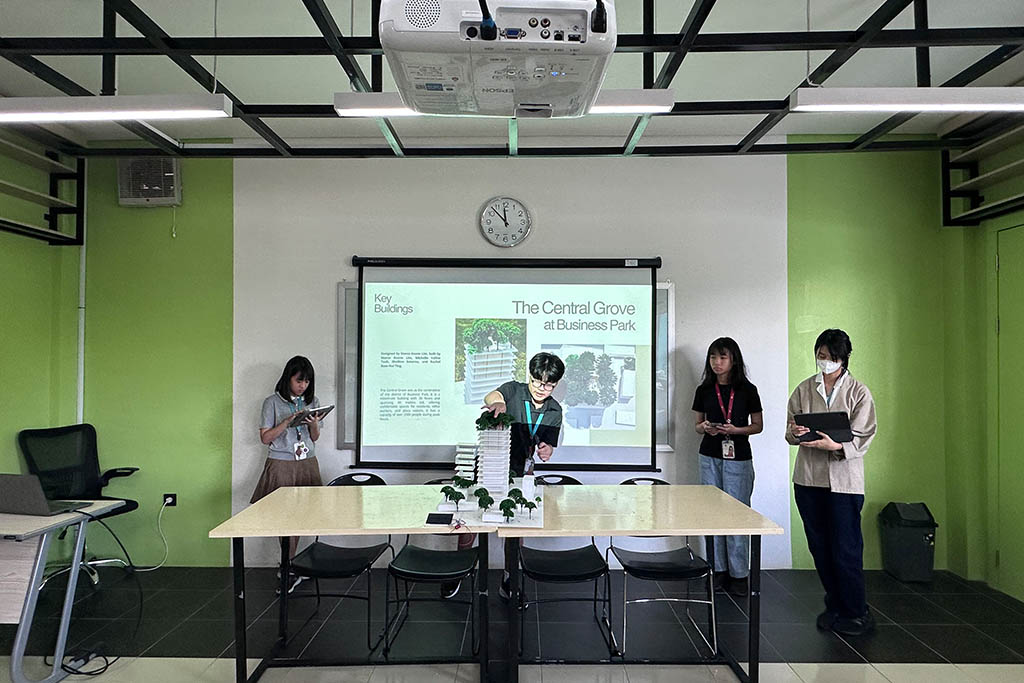
Abigail designed a microcity to combat Jakarta’s chronic flooding and pollution using smart sensors, floating infrastructure, and renewable energy sources. Her model was tested in a simulated flood with successful results—buoyant plastic bottle bases and sensor-triggered alarms worked in tandem to ensure city safety. The project integrated Biology (air quality), Chemistry (eco-materials), Business (financial planning), and Mathematics (scale modelling and evacuation permutations), perfectly representing interdisciplinary learning and entrepreneurship with impact.
A Celebration of Skills and Values
What made these projects exceptional was not just the creativity or academic rigour; they were collaborative, solutions-driven, and deeply personal. Students demonstrated how sustainability is not an abstract concept, but a call to action grounded in science, culture, economics, and community.
Through these projects, our learners:
- Persevered through complex challenges and prototypes,
- Employed analytical thinking to interpret real-world data,
- Strengthened communication and collaboration across peers and disciplines,
- Embodied entrepreneurship and innovation in their ideas and final products.
Final Thoughts
The SIP initiative reflects the core mission of SIS: empowering students to think globally, act responsibly, and lead confidently into the future. As we celebrate these achievements, we are reminded that education is not only about mastering content, but it is about nurturing citizens who are ready to build a better world.
We look forward to even more transformative projects next year.